


Climate of Fear’: ICC Receives Report Linking Duterte to Killings of 59 Lawyers in Philippines

LOS ANGELES – More evidence against former President Rodrigo Duterte will be submitted to the International Criminal Court (ICC) in connection with charges of “crimes against humanity.” This comes from an independent international initiative, Caravana Filipina, which investigated attacks on lawyers, prosecutors, and judges in the Philippines.
In a hybrid press conference held on June 4 at The Hague, Caravana Filipina, a 12-member international delegation that conducted a fact-finding mission last year in the Philippines, announced that it would soon submit its findings and evidence to the ICC prosecutor—particularly concerning the deaths of 59 legal professionals from 2016 to 2022.
Eleonora Scala, program lawyer for the International Bar Association’s Human Rights Institute, emphasized that not only did the state fail to protect its legal professionals, but “the action and inaction of the state have created and sustained this climate of fear, which goes beyond the infringement of individual legal professionals' rights.”
She stated that there is “a grave breach of obligation” on the part of the Philippine government, which “has systematically failed to protect legal professionals from human rights violations.”
“Instead of access to the law, we have people disappearing, communities left without defense, and a judiciary in which the public loses faith because the system no longer works. What we are witnessing is a crisis of trust affecting the entire country,” Scala added.
Gonzalo Saenz Quilez of the International Observatory for Lawyers in Danger also stated that the Philippine state bears responsibility for the physical attacks and extrajudicial killings of legal professionals—whether through direct involvement or acquiescence.
“When the state does nothing in the face of credible threats, when it turns a blind eye to foreseeable violence—that’s not even neutrality; that’s complicity,” he said.
Saenz-Quilez also revealed that, except for one case, none of those they reviewed had proceeded to trial—all were prematurely declared cold cases. “This recurring failure constitutes a blatant and sustained breach of the Philippines’ obligation to investigate violations of the right to life,” he said. “It sends a signal to perpetrators that they will not be held accountable, enabling a pervasive culture of impunity that fuels further violations.”
Scala reported that while 59 killings of lawyers were documented, none had progressed to trial. She emphasized that “some of these cases are not isolated incidents—they reflect a systematic plan to silence dissent.”
“Grounded in consistent, credible, and deeply alarming evidence,” Scala said, “legal professionals in the Philippines have faced, and continue to face, extraordinary risks while upholding the rule of law.”
This climate, she added, is set against the backdrop of Duterte’s war on drugs—a campaign that claimed the lives of thousands of innocent civilians and targeted those who sought to hold the government accountable, including journalists, human rights defenders, and legal professionals.
According to Scala, the report combines research with 10 days of intensive fieldwork (June 4–13, 2024) conducted across the Philippines. The 12 delegates, divided into two teams, interviewed around 100 individuals—victims, relatives of victims, lawyers, journalists, civil society groups, academics, justices, and members of the Commission on Human Rights.
Scala said their findings reveal an escalating pattern of attacks on legal professionals: surveillance, intimidation, red-tagging, the weaponization of the law ("lawfare"), and physical violence—often resulting in extrajudicial killings.
She added that the profiles of the targeted legal professionals are disturbingly similar: all are public interest lawyers, most are organized, and their clients include indigenous communities, workers, fishermen, farmers, religious minorities, and other marginalized groups.
Natalia Segura Diez, program officer of Lawyers for Lawyers, noted that “as Duterte remains detained at the ICC awaiting trial, it is no coincidence that we are releasing our findings in the very place where accountability is being sought.”
She stressed that the organizations involved are not only investigating violations but are also contributing to broader efforts in accountability, solidarity, justice, institutional strengthening, and the defense of the rule of law.
Last year’s mission followed previous investigations into attacks against legal professionals—lawyers, prosecutors, justices, and paralegals—who were targeted for simply carrying out their legal duties.
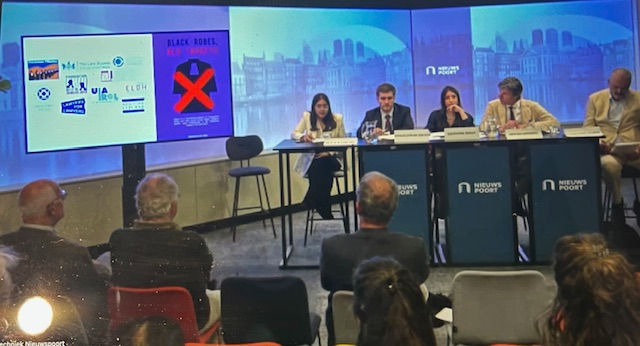
The press conference, titled “Black Robes, Red Targets,” shared its name with a documentary by Jacco Groen, who filmed last year’s fact-finding mission. Alongside Lawyers for Lawyers, the delegation includes representatives from the International Bar
Association, the International Observatory, and other organizations such as:
New York City Bar Association
European Association of Lawyers for Democracy and Human Rights
European Democratic Lawyers (AED)
Day of the Endangered Lawyer Foundation
International Association of Lawyers’ Institute for the Rule of Law
The Law Society of England and Wales
Associació Catalana per a la Defensa dels Drets Humans


Comments